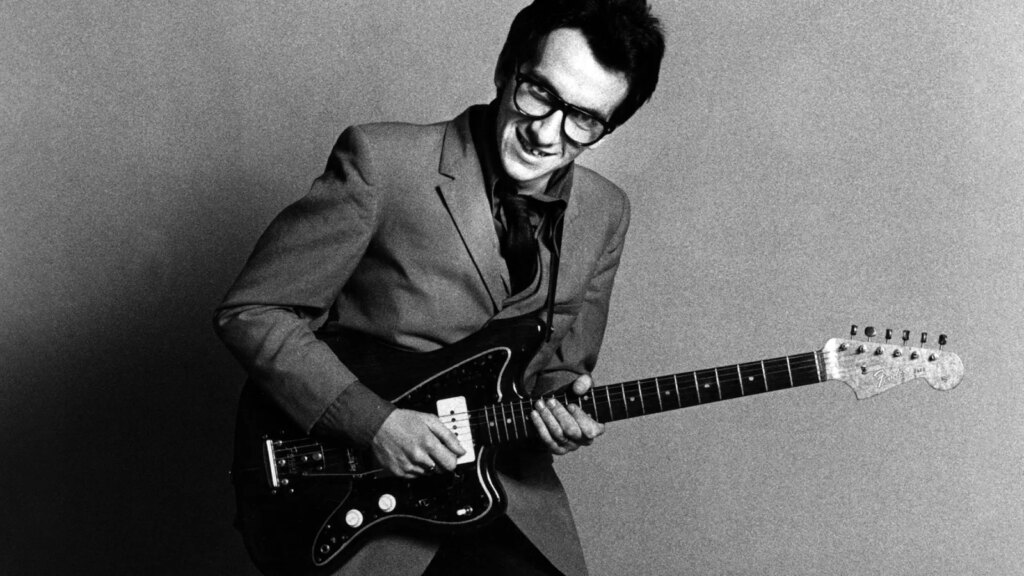
Elvis Costello, the acclaimed British singer-songwriter, made an indelible mark on music history with his debut album, My Aim Is True, released in 1977. Remarkably, he recorded this iconic album in just over 24 hours, all while juggling a day job as a computer operator. In a recent episode of Rolling Stone Music Now, Costello shed light on the creative journey that preceded this instant classic. His insights come as part of the newly released five-disc box set, My Aim Is True (49th Anniversary Edition), which features a remastered version of the album along with previously unreleased content such as acoustic recordings from 1975 and 1976, demos, outtakes, live recordings from his early band the Attractions, and a 2007 benefit concert in San Francisco where he performed with original session musicians.
During the interview, Costello delves deep into his early recordings, sharing the personal stories behind songs and reflecting on the creation of My Aim Is True. He provides insights into the meaning behind tracks like “Alison” and more. For the full conversation, listeners can check out the episode on Apple Podcasts or Spotify, or simply play the episode above. Here are some remarkable highlights from the discussion:
Editor’s picks
Costello’s creative spark for “(The Angels Wanna Wear My) Red Shoes” struck him on a train ride to visit his mother. The melody came to him suddenly, prompting an urgent rush home to capture it. “I was on my way to visit my mother, and the song came into my head,” he reflects. “There were no tape recorders or anything like that that you carried around in your pocket. So I had to make my way as swiftly as possible to my old house, and I ran upstairs and found this old battered guitar. I sat there for about an hour until I had it drilled into my brain and wouldn’t lose it.” As for the inspiration behind the red shoes, he admits, “I have no clue. I just figured they were something that didn’t feature in my wardrobe, and those angels would definitely want them.”
Interestingly, Costello almost released his early recordings 35 years ago. He reflects on why those recordings, captured in 1975 and 1976 and included in The Blue Print, never saw the light of day. “I cannot for the life of me think why I felt they revealed too much,” he recalls. “I was on the verge of releasing them and then thought, ‘No, … everybody will see.’ It was like showing your pictures in clothes that you now know don’t suit you.” With a fresh perspective, he articulates his feelings now: “They just sound like somebody learning, and there should be nothing embarrassing about that.” He hopes that those early songs may inspire younger writers, noting, “you can hear the ambition to do something, and it isn’t quite formed.”
Additionally, Costello recounted a humorous moment when his label, Stiff Records, suggested changing his name. Initially, he thought it was a prank. “They were the ones that held the cards,” he explains. “I didn’t have any company except that one, so I went along with it.” He notes that the label’s promotional efforts emphasized his “ordinariness” and played into his image, describing how his glasses became symbolic of the “Clark Kent” archetype.
Surprisingly, Costello does not identify with the “new wave” label. “I never felt part of any gang,” he states candidly. “I hated the whole new wave thing. It was completely made up. It was just journalists explaining bands that had energy and a little edge.” He challenges conventional narratives of 1977, stating, “the big book of history version” is inaccurate, as it suggests punk influenced everything. “Most of the great groups were struggling down there in the 30s and 40s,” he shares. His candidness extends to his experiences on television, where he felt initial exposure hurt his record sales, saying, “When people got a look at us, the record usually went down the charts the next week.”
Trending Stories
Related Content
In a moment of reflection, Costello admitted to regretting his initial rudeness towards Linda Ronstadt’s cover of “Alison.” He shared, “It was on a very big hit record by Linda Ronstadt… And I was just allergic to that sound.” Recognizing the talent involved, he expressed embarrassment over his previous comments, acknowledging, “that I would be chosen in the company of Lowell George and Warren Zevon… was a tremendous compliment, and I just didn’t know how to take it gracefully.”
Finally, in a light-hearted moment, Costello humorously compared his affiliations, revealing a preference for the Muppets over the Ramones. He pointed out that during the release of My Aim Is True, both the Muppets and the Ramones were chart-toppers. Costello remarked, “The Muppets had great songwriters too. Paul Williams.” He amusingly noted his own progression through the Muppets’ characters, stating, “I was closer to Oscar the Grouch, actually, initially, and then gradually was working towards Sam the Eagle.” He then shared the extraordinary experience of singing with Kermit the Frog, remarking on how extraordinary it was.
In conclusion, Elvis Costello’s reflections on his early artistic days offer a unique glimpse into the mind of a musical legend. The release of the My Aim Is True (49th Anniversary Edition) not only honors the past but also provides fresh insights into his creative evolution, making it a must-listen for fans and newcomers alike.