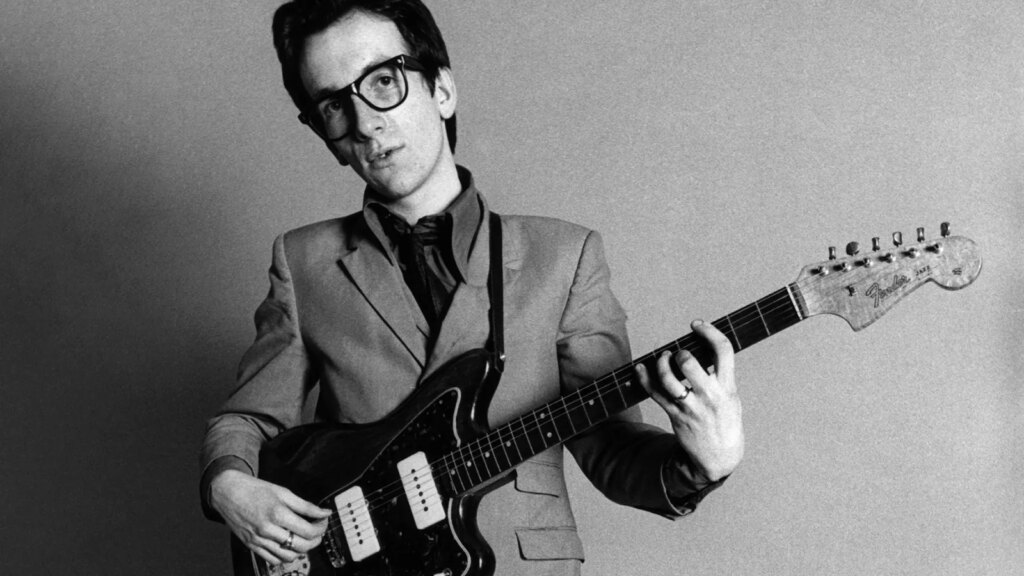
In celebration of the 49th anniversary of his debut album My Aim is True, Elvis Costello has released a comprehensive 104-track boxed set, hailed as one of the year’s best reissues. This edition not only features previously unheard songs but also showcases live performances that span his entire career. Among the highlights are early tracks that illustrate his diverse stylistic range, hinting at the musical explorations that would define his later work in roots, country, and pre-rock balladry.
In a recent episode of the Rolling Stone Music Now podcast, Costello reflected on the creation of My Aim is True, discussing notable moments from the boxed set and his artistic evolution. A condensed version of the interview is available below, with the complete episode accessible via Apple Podcasts or Spotify.
Divine Disgust and Young Reflection
Costello’s lyric, “I used to be disgusted/ Now I try to be amused” from the track “(The Angels Wanna Wear My) Red Shoes” has become emblematic of his first album. He recalls the inspiration for the line coming to him while traveling to visit his mother: “I was on my way to visit my mother, and the song came into my head.” He reflects on the emotional depth of the lyrics and their exploration of mortality, noting that even at the age of 22, he grappled with such profound themes.
Reflections on Disappointment
When discussing his youthful perspective, Costello shared, “No, but I think maybe that’s also a little bit like saying, ‘I’m gonna be disappointed before you disappoint me.’” He sees the sentiment present in several of his songs, acknowledging a common thread of disappointment in his early work, which is distinct from punk’s push for a radical reset. Costello emphasizes that while punk sought to sweep away the past, his music drew from a wider array of influences, foreshadowing his eclectic future.
The Intersection of Pop Culture
Moreover, Costello noted a curious juxtaposition in the charts of his era: “The Ramones and the Muppets were in the top 20 simultaneously.” He argues that despite punk’s reputation for dominance, many artists, including himself and the Boomtown Rats, struggled to find a place in a landscape filled with disco and soft rock. He humorously pointed out the contrast between iconic bands and the Muppets, explaining that while he admires the Ramones, the Muppets represent a different form of creativity and entertainment.
A Musical Evolution
Costello’s musical journey traces back to his formative songwriting years, where diverse influences, including Springsteen and Van Morrison, played pivotal roles in shaping his sound. He reflects on the ragtime-inspired songs from this period, mentioning their origins as attempts to conjure up historic sounds reminiscent of the 1920s. These tracks, some of which had never been released until now, provide a glimpse into his artistic evolution and burgeoning confidence as a songwriter.
The Birth of ‘Alison’
One of his most enduring songs, “Alison,” emerged from an encounter with a supermarket cashier—an experience that inspired a romantic narrative. Costello explains, “I never wanted to tell people, have this mental image of somebody,” revealing his intention to evoke a broader feeling rather than fixate on a specific individual. He clarifies that the song wasn’t meant to be a murder ballad, explaining how misinterpretations can arise from the lyrics.
Insights on Identity
Addressing the significance of his stage name and the evolution of his artistic identity, Costello recounted a time when his record label suggested changing it. Initially unsure if it was a prank, he ultimately underwent a transformation that included adopting a look that emphasized his “ordinariness.” He humorously noted his glasses became symbolic of a nerdy character, blending a sense of humor with a critique of the industry’s pressures to conform.
Enduring Legacy and Future Prospects
As he reflects on his career, Costello remains engaged in various creative projects and has no immediate plans for new music. He acknowledges how his earlier works remain relevant, asserting, “If anybody younger is curious to see what’s going on in this, they will see the same sort of things as they might encounter in their work, in their attempts to find their voice.” With the release of this retrospective boxed set, Elvis Costello offers a treasure trove of music that showcases his remarkable journey and enduring impact on the landscape of popular music.
In closing, he hinted at a new production of his musical adaptation of A Face in the Crowd, ensuring that his creative endeavors continue to evolve. As ever, Costello remains a compelling figure in music, blending nostalgia with innovation as he celebrates his past while looking toward the future.