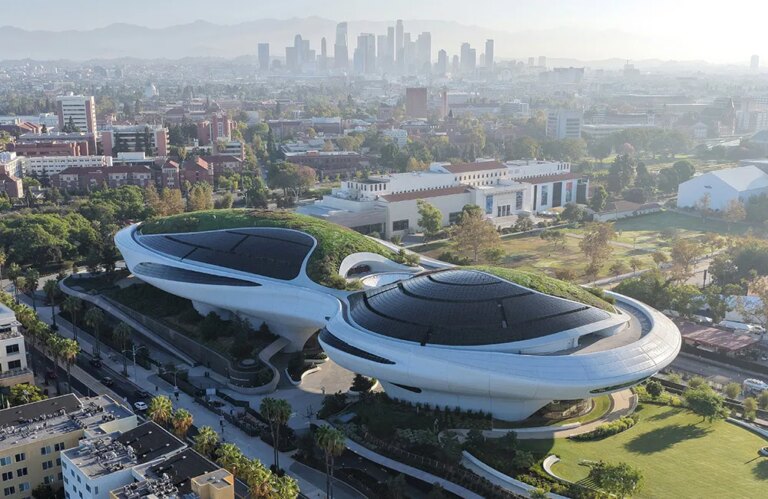
George Lucas, the visionary filmmaker behind the iconic Star Wars franchise, has crafted a one-of-a-kind cultural institution in downtown Los Angeles: the Lucas Museum of Narrative Art. As a colossal new addition to the city’s cultural landscape, the museum prominently features an extensive gallery of Star Wars memorabilia, including beloved artifacts such as R2-D2 and Darth Vader’s suit, showcasing the very essence of the franchise that established Lucas as a titan of Hollywood.
A Monument to an Eccentric Visionary
At 82, Lucas has infused the museum with his unique artistic vision and influences, reminiscent of the Gilded Age’s eclectic cabinets of curiosities associated with figures like P.T. Barnum and Henry Clay Frick. This ambitious project, described as a personal endeavor with both ego and art at its core, may be viewed as a grand challenge that only someone with significant resources could attempt. His creative approach merges various styles and ideas, establishing a new cultural nexus that reflects Lucas’ narrative-centric aesthetic.
Creative Control and Populist Mission
As the museum’s September 22 opening approached, Lucas took a hands-on role, particularly after previous leadership changes in 2025. His refusal to back down from critics led the project to its ultimate home in L.A., following failed attempts in both San Francisco and Chicago. “I’m a contrarian,” Lucas candidly remarked during a press conference on September 2. “I don’t like to do things that people think can be done.” He has emphasized a populist mission that bridges high and low culture, celebrating what he refers to as “narrative art,” which he describes as both “an illegitimate child of art” and “the people’s art.”
Eclectic Curatorial Vision
The exhibits juxtapose diverse works, from Frida Kahlo paintings to Garfield comic book panels, illustrating the museum’s foundational belief in the importance of storytelling. Notably, Norman Rockwell’s “The Runaway” (1958) is placed alongside Richard Williams’ “The Militarization of the Police Department” (2014), prompting discussions about narrative and imagery across contexts.
A Total Work of Art
The Lucas Museum exemplifies Lucas’ auteurism, resonating with his earlier accomplishments in creating immersive cinematic experiences through institutions like Industrial Light & Magic and Skywalker Sound. He likens the museum’s creation to filmmaking itself; from casting the collection to curation and installation, each aspect plays a crucial role in telling a cohesive narrative.
A Contemporary Cultural Institution
While many museums are guided by their namesake benefactors, the Lucas Museum stands apart through its audacious approach to culture and prescriptive vision. It aligns with a lineage of pioneering patrons like Albert C. Barnes and Bill Paley, who redefined how art and culture are perceived and curated. Each of these figures sought to celebrate forms of artistic expression typically overlooked, creating environments that encourage new interpretations of “art.”
Legacy and Future Directions
The museum’s future will likely reveal deeper reflections on its founding narrative, much like presidential libraries mature over time as scholars analyze their subjects’ legacies. For instance, future exhibits may neutrally assess controversial components of Star Wars, such as the topic of the “slave Leia” costume. Lucas remains unabashed about his creative decisions, as highlighted by his wife, Mellody Hobson, who noted that he has no regrets over his artistic choices.
Among the museum’s standout features is a monumental bronze sculpture entitled Princess Leia Frees Herself from Jabba the Hutt, embodying a moment that speaks to both empowerment and the legacy of the franchise.
As visitors flock to the Lucas Museum, it emerges not just as a shrine to commercial success but as a new dialogue about narrative art, culture, and storytelling that will resonate for generations to come.