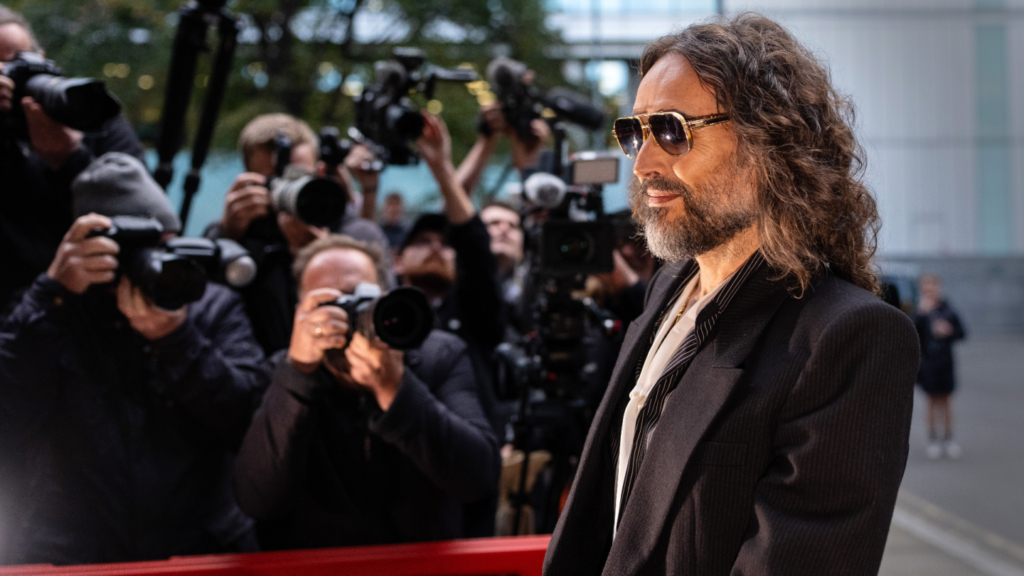
Russell Brand’s rape trial has commenced at London’s Southwark Crown Court, with the prosecution labeling him a “ruthless” and “calculated” sexual predator. The courtroom proceedings have drawn significant media attention, leading officials to establish an “overflow room” for journalists due to the high turnout, according to BBC News coverage.
Jury Selection and Attendance
The jury consists of eight men and four women, who were selected earlier this week. On Wednesday, Brand was seen arriving at the court alongside his wife, Laura, who reportedly smiled supportively at him during the proceedings.
Allegations Against Brand
Brand, who gained fame through his roles in Big Brother’s Big Mouth and Forgetting Sarah Marshall, faces serious charges including three counts of rape, three charges of sexual assault, and one allegation of indecent assault. Six women have accused him of crimes that allegedly occurred between 1999 and 2009. Brand has denied all allegations, expressing to reporters, “I feel blessed. I feel, of course, concerned, but hopeful that this process will lead to good outcomes for everybody — that is my prayer.” Following the emergence of these allegations, Brand has embraced Christianity and been baptized.
Prosecution’s Opening Remarks
In her opening statement, lead prosecutor Riel Karmy-Jones detailed the claims against Brand, asserting that he acted in a “ruthless and calculated” manner. She emphasized the independent nature of the women’s accounts, pointing out that they had never met before coming forward. Karmy-Jones described Brand’s desire for sexual contact as “indiscriminate and voracious,” and quoted a former associate who claimed Brand boasted about wanting to “bed 5,000 women” throughout his lifetime.
Individual Complaints Detailed
The first complainant alleged that she was raped by Brand. At the time, she was in her 20s and reportedly believed he was gay. After stepping away to use the bathroom, she returned to find Brand partially undressed. The prosecution claims he manipulated her into a sexual encounter “against her will.” During police questioning, Brand admitted to not recalling the incident but maintained he had never engaged in non-consensual activities.
The second complainant, who worked at MTV in 2001, detailed an incident of indecent assault. After complimenting Brand’s T-shirt, he allegedly offered to give it to her, then forcefully grabbed her forearm when she led him to the restroom. She was able to escape his grasp after struggling.
The prosecution recounted the experiences of a third complainant who met Brand at a party in Soho in 2004. She reported that he suddenly grabbed her breasts and pulled her toward the restrooms while displaying a “big, weird grin.” Although Brand allegedly exposed himself to her in a vehicle later that night, the woman rejected his advances.
Another complainant revealed that in an incident at Capital Radio in 2004 or 2005, Brand aggressively grabbed her face and body against her will. Despite her attempts to resist him, Brand continued his advances until she managed to push him away.
A fifth complainant, the youngest among the accusers, met Brand at the Hammersmith Apollo in 2009. She stated that the encounter began consensually but quickly turned non-consensual, as she reported Brand raped her anally while she explicitly asked him to stop. This incident reportedly left her feeling traumatized and anxious for years afterward.
Another allegation involves a sixth complainant who accused Brand of sexual assault in 2009. She claimed he insisted on a massage and became displeased when she refused. In a troubling display, Brand allegedly fell to his knees and pressed his head into her groin area. Although she raised the issue within her workplace, she felt her complaint wasn’t taken seriously.
Brand’s Denials and Continuation of Trial
Brand has categorically denied all allegations made by these six women. Toward the conclusion of Wednesday’s proceedings, the jury was reminded of his earlier prepared statement, in which he asserted he has “never engaged in non-consensual sexual activity,” claiming the accounts were based on erroneous narratives arising from a defamatory documentary and subsequent press coverage.
The trial is expected to last up to 10 weeks, as the court works to examine the evidence and testimonies presented throughout the proceedings.