Previously on the MCU:
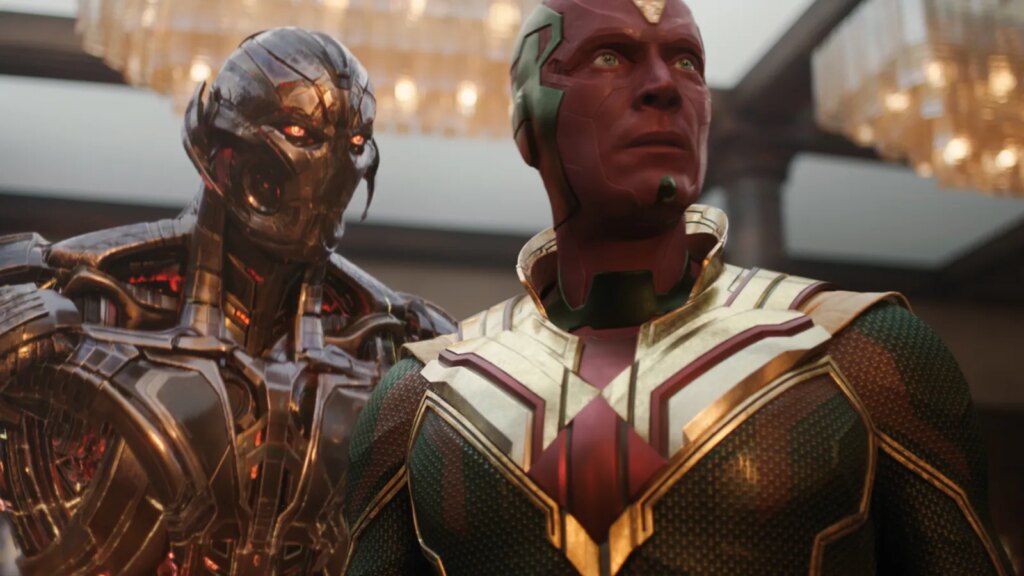
To recap, Vision, an artificial being known as a synthezoid, was created by the malevolent AI Ultron. Activated by the Avengers, he ultimately turned against his creator, leading to Ultron’s downfall. Powered by the “Mind Stone,” one of the Infinity Gems infamous for their catastrophic potential, Vision himself is later killed. However, his beloved, Wanda Maximoff, a.k.a. the Scarlet Witch, resurrects him through a complex magic hex. The last time we saw him, he was embroiled in a confrontation with “White Vision,” a version of himself stripped of memories, which resulted in the latter taking off after acquiring this knowledge. [starts to hyperventilate].
These events are briefly summarized at the beginning of VisionQuest, the new series from Marvel Studios set to premiere on Disney+ on Oct. 14. However, viewers would benefit from revisiting previous chapters of the MCU before diving into this series. It is essential to rewatch WandaVision, which remains the best offering from Marvel’s small-screen endeavors. Additionally, a refresher on Avengers: Age of Ultron (2015) is advised, especially if it’s been a while since you last saw it. Exploring online breakdowns of Agatha All Along, a spin-off from WandaVision, could also enhance your understanding. Comic book aficionados might even want to dust off their copies of West Coast Avengers and the classic Jim Shooter/George Perez run of Avengers from the late 1970s.
Of course, one could attempt to consume VisionQuest as an isolated eight-episode limited series revolving around one of Marvel’s countless superheroes, but this approach is not recommended.
Like many Marvel productions, VisionQuest is intricately tied to prior installments and primarily crafted for dedicated MCU fans who revel in Easter eggs and can recall extensive backstories. The notion that a bit of “homework” is required has become a cliché, but it’s not unheard of for Marvel to deliver compelling stories rooted in esoteric comic material that doesn’t necessitate an advanced degree from the Marvel Cinematic University to enjoy. (Shout out to Werewolf by Night.)
Editor’s picks
However, there’s something insular about VisionQuest; it serves as a prime example of the critique that Marvel often produces high-budget, spectacle-driven entertainment for a niche audience. This series feels primarily aimed at die-hards and bots rather than a broader audience.
What has our introspective android been up to since we last checked in? Vision (Paul Bettany) is now living incognito, assuming human form and working as a bartender in Edinburgh. During his downtime, he powers down and retreats into a virtual estate shared with other sentient AIs. Among them are J.A.R.V.I.S. (James D’Arcy), his former assistant; F.R.I.D.A.Y. (Orla Brady), his tactical officer; the bumbling duo D.U.M-E (Henry Lewis) and U (Jonathan Sayer); and the unpredictable E.D.I.T.H. (Emily Hampshire), who toys with game theory, leisure, and weaponry.
Living above the virtual estate is Ultron (James Spader). Yes, that Ultron. Despite Vision having destroyed the remnants of Ultron’s physical form, he nonetheless transferred the AI’s consciousness into this space out of a sense of mercy, leaving Ultron, the creature who once aspired to annihilate humanity, confined yet still processing his complex thoughts. In this surreal partnership, Vision lamented, “Humans remain to me contradictory creatures,” while Ultron humorously countered, “You don’t have to tell me, I tried to kill them all.” It seems even the most nefarious villains can turn into a source of dark humor.
Related Content
The dynamic between Ultron and Vision forms the highlight of VisionQuest. Spader excels at sarcasm, providing a perfect foil for Bettany’s earnestness. This witty exchange offers a much-needed contrast to the show’s introspective themes. The narrative plays with the idea established in WandaVision regarding Vision’s true identity through the “Ship of Theseus” analogy—if Vision is both himself and not himself, the question becomes: who is he truly? As F.R.I.D.A.Y. poignantly asks, “How can anyone know you if you don’t know yourself?”
Bettany’s portrayal of this nuanced character, whom he has embodied for over a decade, strikes the right balance between profound introspection and approachable storytelling. Showrunner Terry Matalas alongside his team focus on the quest aspect while allowing for moments of levity, such as Vision’s kitchen stocked with “Vibranium Foil.” This blend of humor and drama seems promising—initially.
However, as the series unfolds, the balance shifts. A pickpocket in London—possibly Tommy Maximoff, Vision’s estranged son—sparks an investigation into a series of murders linked by a mysterious figure, as bounty hunters and killers become intertwined in the narrative, hinting at deeper ties to the MCU lore familiar to dedicated fans.
Trending Stories
The filters imposed on media coverage by Marvel Studios limit our discourse on key plot details. We can anticipate a plethora of in-universe references, and if they had a music budget large enough to feature John Denver’s “Calypso” and Glen Campbell’s “Rhinestone Cowboy,” they certainly would maximize this opportunity. A familiar character from the MCU makes an appearance toward the end, eliciting cheers from a select few while leaving the majority lost in confusion as they scramble to understand the significance.
A strong start for VisionQuest does not guarantee a powerful conclusion. Even when it revisits WandaVision’s innovative television format, it often feels like a case of too little, too late. While blending elements of a Marvel team-up and continuing a supporting character’s journey, the show ultimately reverts to typical MCU tropes, resulting in a cacophonous display that seems to signify little. The upcoming release of Avengers: Doomsday in December further emphasizes this notion; instead of a profound exploration of an android’s psyche amid contemporary anxieties regarding AI, VisionQuest emerges as a placeholder in a larger narrative puzzle, lacking its own vision in the process.