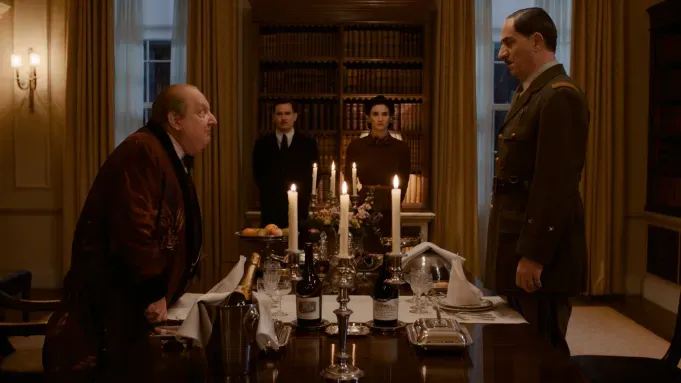
At the American French Film Festival in Los Angeles, Antonin Baudry’s two-part World War II epic, “De Gaulle,” made its U.S. premiere and received a resounding seven-minute standing ovation after both installments screened to packed audiences at the DGA Theater. This ambitious €74 million production, starring Simon Abkarian as Charles de Gaulle and Simon Russell Beale as Winston Churchill, is among Pathé’s most daring projects, following its successful adaptations of “The Count of Monte Cristo” and the two-part “The Three Musketeers.”
From France to International Acclaim
Initially facing a slow start in France, “De Gaulle” gained momentum through word of mouth, transforming into a domestic box office hit with over six million tickets sold. The first installment, “De Gaulle: Resistance,” which chronicles de Gaulle’s efforts to establish a Resistance movement after France’s surrender to the Nazis in 1940, has become the highest-grossing French-language film of the year in the U.K. Additionally, the film’s acquisition in China, where Light Films plans to release it in late November, marks a formidable achievement.
A Nationwide Release Strategy
In the U.S., Samuel Goldwyn Films is rolling out “De Gaulle” in major markets like New York, Los Angeles, Chicago, and San Francisco, while also making it available nationwide via transactional VOD. The second installment, “De Gaulle: Liberty,” is set for a December release. Goldwyn expressed confidence that the film’s sweeping narrative could resonate with American audiences, despite de Gaulle being a less familiar figure.
A Unique Historical Perspective
Goldwyn emphasized that the remarkable story of de Gaulle offers a new perspective on World War II that U.S. audiences may find intriguing. He noted, “The films have proven themselves, and audiences are audiences, whether they’re American or French.” By illustrating the fraught relationships among de Gaulle, Churchill, and Roosevelt—played by Campbell Scott—the film challenges established American and British narratives of the war.
Unpacking Historical Complexities
Director Baudry and co-writer Bérénice Vila undertook extensive research, analyzing over 150 books and historical documents to portray de Gaulle’s transformation from an obscure officer to the leader of the French Resistance. Baudry explained, “All of this history has never really been told,” highlighting the complexities of the leaders’ relationships that are often overlooked in traditional accounts of World War II.
Approaching De Gaulle: A Challenging Role
Abkarian’s preparation for the role of de Gaulle involved six months of intense study and characterization. He meticulously annotated the screenplay and even transcribed his lines into a notebook, which he later gifted to Baudry. Abkarian remarked, “You can’t represent a character like this in a strictly anthropological way,” indicating the challenge of authentically capturing de Gaulle’s essence without resorting to caricature.
Building Relationships Through Acting
Within the film’s context, de Gaulle and Churchill are portrayed as complex allies. Abkarian found a kindred spirit in Russell Beale, noting, “Simon is an incredible actor who has a profound understanding of great texts.” He reflected on their characters being bound by a romantic idealism that set them apart from Roosevelt’s pragmatism, enhancing the depth of their on-screen dynamic.
Connecting with a Modern Audience
While Goldwyn is optimistic about the films resonating with U.S. viewers, Abkarian remains cautiously hopeful. He believes that de Gaulle’s defiance might connect with contemporary American ideals. “There may be something in De Gaulle’s struggle that speaks to Americans’ own battles,” he noted. Goldwyn encapsulated this sentiment by emphasizing de Gaulle’s patriotism: “This man was very patriotic; he didn’t go along with what his government dictated.”