“Wicker,” now playing in theaters, lives up to the buzz surrounding it, proving to be as humorous, romantic, and enchanting as its trailer promised.
Olivia Colman and the Village of Misfits
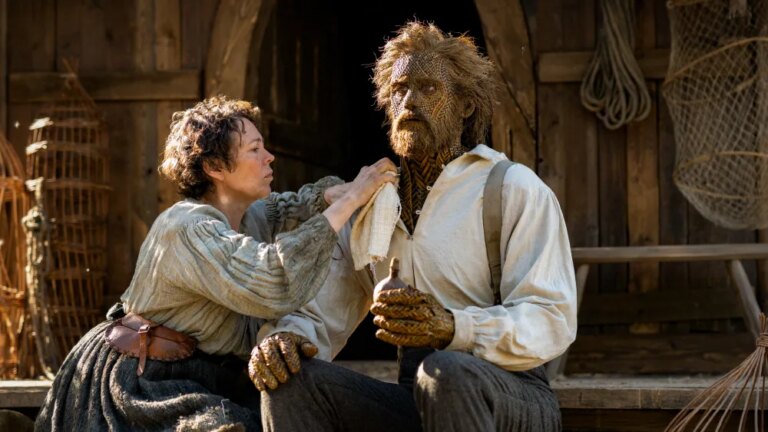
In the film, Olivia Colman stars as a spinster fisherwoman in a medieval community where a woman’s worth is often determined by her marital status. Despite her fierce independence, the townspeople ridicule her for her choice to make a living on her own. That is until she approaches the local basket weaver, portrayed by Peter Dinklage, with an unusual request: to create a wicker husband.
Introducing the Wicker Man
Enter Alexander Skarsgård, whose transformative performance features an elaborate ensemble crafted through extensive makeup and prosthetics. The actor dons a suit and prosthetic makeup that ingeniously render him into a man made entirely of wicker.
A Collaborative Vision
The film’s concept originated with writers Alex Huston Fischer and Eleanor Wilson, who adapted Ursula Wills’ short story “The Wicker Husband.” Their vision caught the attention of Weta Workshop artists, prosthetic makeup designer Joe Dunckley, and lead makeup FX artist Sarah Rubano. Dunckley recalls, “They wanted to make this practically,” emphasizing the importance of creating a piece of art that illustrated the filmmakers’ vision.
Innovative Techniques in Costume Design
The development team dedicated 18 months to research and innovation. Traditional prosthetic materials mimic human skin, but the challenge of creating a character made of wicker required a different approach. Dunckley notes, “We thought that if we could get the strands of the weave to be individual and get them to move as if they were individual muscle fibers that drove his movement, then he could be a believable sentient wicker being.” This led them to embrace modern technology, specifically 3D digital sculpting and printing.
Starting with a full-body scan of Skarsgård, they sculpted bespoke pieces for him. The intricate basket weave was crafted using a new powder-bed laser-sintered printing process, allowing them to create detailed designs mimicking the natural movement of wicker.
The Secret Behind Comfortable Scenes
For the film’s provocative scenes, viewers may wonder how Colman managed to avoid splinters. The answer lies in Skarsgård’s costume, which consisted of 50 individual 3D-printed components that were painted to resemble wicker and sewn onto a soft spandex suit, ensuring that no actual straw was involved. Dunckley explains, “It’s a semiflexible material, not too dissimilar to the feeling of touching proper wicker weave.”
The Intricacies of Makeup Application
Rubano, who focused on the makeup side of the costume, created ten distinct prosthetic pieces for Skarsgård’s character. She describes the process: “We had ears, eye bags, and lips. We had an underlip piece and a jaw piece, and the larger forehead, nose, cheekbones—with plenty of hand painting around his eyes.”
His facial hair was crafted from muka, a silky-soft fiber obtained from the harakeke plant. This choice allowed the team to style the hair as one would human hair, maintaining Skarsgård’s expressive identity amid the elaborate makeup. Dunckley further explains, “We could track the expressive range of the face so that we could engineer into the weave the ability to move for his expression.”
Skarsgård’s full transformation could be accomplished in less than two hours, with the time dwindling to about 90 minutes by the film’s end. Rubano praises Skarsgård’s dedication, noting how his humor and patience enhanced the collaboration.
Addressing the Wicker Elements
One of the quirky conversations surrounding the film involves the practicality of Skarsgård’s “wicker penis.” Dunckley notes, “There’s been a lot of speculation about just the mechanics of how this would work and about the potential danger of a wicker penis.” He humorously concludes that a skilled basket maker would surely know how to weave it to make it user-friendly.
Rubano credits costume designers András Dániel Tóth and Attila Godena-Juhász for ensuring authenticity, especially with a last-minute addition of the woven element for a key scene. “They did such a great job because it was very last minute, but it’s puff spandex. The weave was 3D, so there was dimension to it. From a distance, they color-matched it so beautifully,” she said.